

AI GOVERNANCE
AI governance for the assets your teams actually use
Most AI governance search results talk about policy frameworks and model risk. Those matter — and they still leave a gap if you cannot control the skills, prompts, MCPs, secrets, and agents your people run every day. Joyst is an AI governance platform for that asset layer: permissions, folders, and an audit trail. Not a generic GRC suite. Not an IDP with scorecards.
ASSET-FRAMED
AI governance platform — asset-framed
- Skills, prompts, MCPs, secrets, agents
Joyst’s AI governance platform lane is the asset layer your teams actually use — not a policy PDF programme or a model-risk checklist alone.
- Productised control
Permissions, folders, and audit on catalogue assets. What Joyst governs is productised control of that layer — not a generic GRC suite.
- Not ethics-as-product
Responsible-AI programmes and compliance frameworks still matter. They still leave a gap if nobody controls the skills, prompts, MCPs, secrets, and agents in daily use.
PERMISSIONS
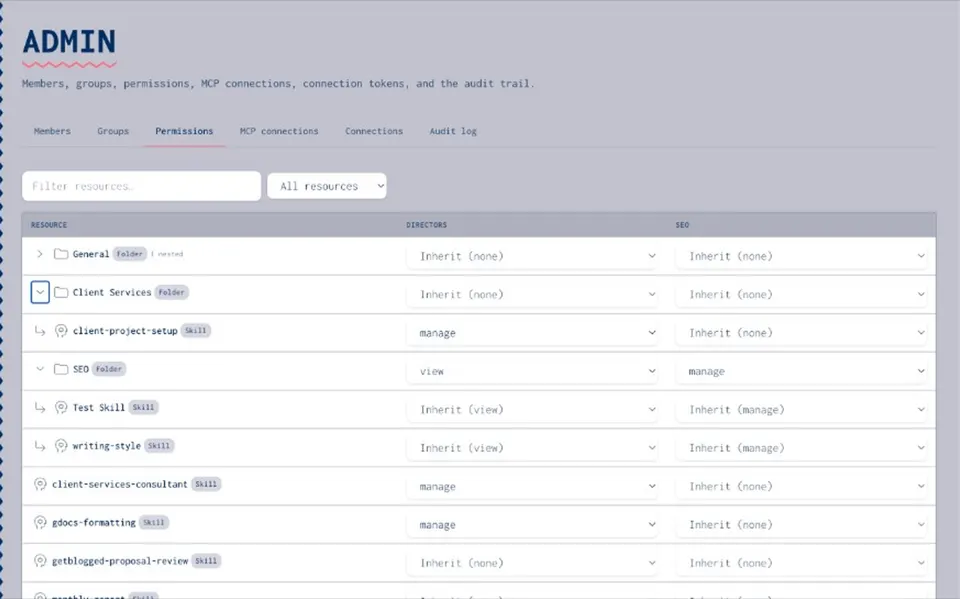
Permissions that match how teams work
- View, use, and manage
View / use / manage tiers map to real work. Groups and folder bulk permissions keep large catalogues workable. Drafts stay private until ready.
- Groups and folders
Grant rights on assets and folders for the right groups so platform and security buyers scale access without a ticket queue nobody will use.
- One model across pillars
The same permission model covers prompts, skills, MCP entries, secret references, and agent packages — so governance does not fragment per tool.
AUDIT
Audit trail
- Who changed what
See who changed which prompt, skill, MCP entry, secret reference, or agent package — instead of “someone updated it in Slack.”
- Central review
Review changes across the private team catalogue so ops and security share one picture of what moved.
- Tied to permissions
Audit sits beside view / use / manage rights — who can change an asset and who did change it stay linked.
APPROVED USE
Approved catalogues
- Prompts and skills signed off
Tie governance to approved prompts and published skills so everyday reuse stays within what the org has signed off.
- MCP allow-list
Allow-list MCP servers the team and agents may use — rather than unmanaged one-off connections.
- Secrets kept out of context
Approved catalogues and secrets kept out of model context keep packages within signed-off use.
AGENTS
Agentic AI governance
- Govern packaged agents
Governing agents means governing what packages include and who can publish or use them — including MCP tools and how secrets are referenced.
- What agents can call
Control which approved skills, prompts, and MCP servers agent packages may pull — not inventing one-off ingredients per harness.
- Not a multi-agent runtime
Joyst governs packaged agents and what they include. It is not a multi-agent orchestration runtime.
BESIDE YOUR IDP
Beside your IDP — not instead
- Different catalogues
IDPs catalogue software services and scorecards. Joyst catalogues the AI asset layer — skills, prompts, MCPs, secrets, and agents.
- Use both
Platform teams keep their IDP for services. Joyst sits beside it for the AI assets those services and agents consume.
- Not a replacement claim
We do not replace Backstage, Port, OpsLevel, or Cortex. Beside your IDP — not instead.
Prompt management
Prompt managementSkills registry
Skills registryMCP catalog
MCP catalogSecrets vault
Secrets vaultAgents
AgentsBeside your IDP
Beside your IDPAI governance FAQ
Permissions, folders and an audit trail over the AI assets your teams actually use — skills, prompts, MCPs, secrets and agents — in a private organisation catalogue. Not a generic GRC or responsible-AI ethics programme sold as product.
IDPs catalogue software services and scorecards. They still leave a gap if skills, prompts, MCPs and agent packages spread ad hoc. Joyst sits beside the IDP for that AI layer.
When agents are packaged setups — govern what packages include and who can publish or use them, including which MCP tools and how secrets are referenced. Joyst isn’t a multi-agent runtime.